 Skip to content
Stop building forecasts by hand.
Let your data do the work.
Pigment Predictions brings machine learning directly into your planning workflow. No data science team, no exports, no hand-off to IT. QueBIT configures driver-based prediction models that give your team a stronger, more defensible baseline to plan from.
THE CHALLENGE
Manual forecasting is slow, inconsistent, and already outdated
Traditional forecasting relies heavily on manual extrapolation. Analysts look at last year's actuals, apply a growth factor, and call it a forecast. By the time it reaches a decision maker's desk, it is already stale.
This approach is time-consuming, difficult to scale across teams, and almost impossible to audit. It also hides uncertainty behind a single point estimate, giving decision makers false confidence in numbers that reflect one analyst's assumptions more than the actual data.
The Pigment Predictions Difference
Pigment Predictions generates statistically-driven forecasts from your own historical data, inside the same platform you already use to model, plan, and report. Business users run the models themselves. QueBIT makes sure those models are configured to produce output that is actually reliable.
1. Select your data
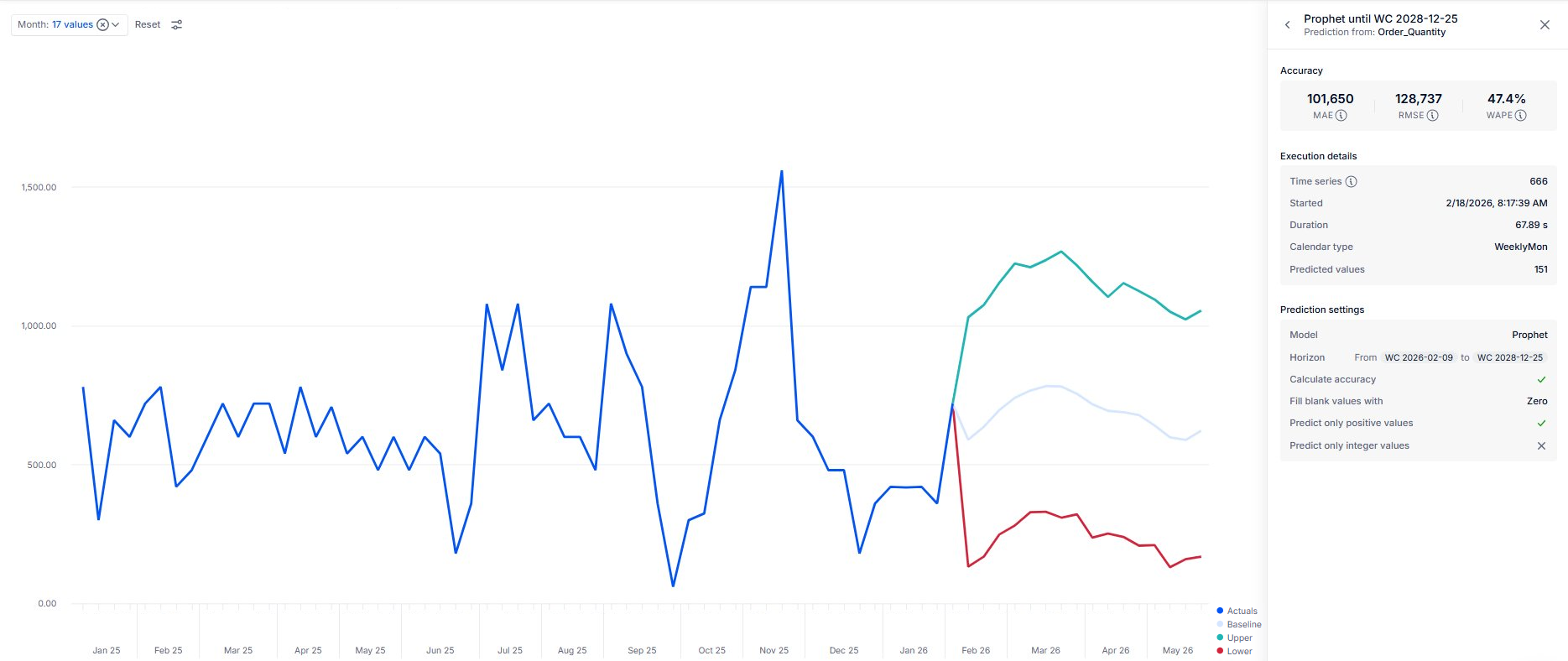
Use Predictions with a time series metric in your Pigment application. Examples include: revenue by month headcount by week, volume by region.
2. Configure the model
Set the forecast horizon, choose an algorithm, include external factors, and define accuracy metrics.
3. Generate the forecast
The model produces a forward-looking prediction with confidence intervals showing the expected range of outcomes.
4. Save and apply
Store results as a Pigment metric to use as a baseline, adjust with planner judgment, or compare against manual assumptions
How Pigment Predictions Works
Statistical forecasting built into Pigment
Pigment Predictions allows planners to apply machine learning models directly in Pigment. No data science background required. The entire process happens inside the platform.
The models analyze historical trends in your data and project future values, along with confidence intervals that show the expected range of outcomes. You can include external factors to further improve accuracy where those factors are available and relevant.
Once a forecast is generated, results are stored as a metric inside your Pigment application where they can be reviewed, adjusted with planner judgment, or used as a baseline alongside driver-based assumptions.
Why IT Matters
Better baselines. More time for decisions.
Predictions improves on manual forecasting in several meaningful ways that directly affect how your planning team spends its time.
Reduce manual effort
Statistical baselines are generated automatically, freeing planners to focus on judgment-driven adjustments rather than mechanical number crunching.
Surface seasonality and trends
Time-series data is generally highly seasonal, which is difficult to identify manually. Predictions picks up these patterns automatically from your historical data.
Make uncertainty visible
Confidence intervals give decision makers an honest view of the range of likely outcomes, not just a single point estimate that implies more certainty than exists.
Learn from your own history
The model learns from your own historical data. Including external factors can further improve accuracy where those factors are relevant to your business.
Native vs. Configured
What Pigment predicts natively vs. what QueBIT layers on top
Pigment Predictions is powerful out of the box. QueBIT's configuration work adds the driver logic, data quality controls, and planner guardrails that make output actionable in real planning cycles.
| Capability | Pigment Predictions (Native) | QueBIT Configuration Layer |
|---|---|---|
| Forecast generation | Time-series statistical forecasting from historical data within Pigment | Driver-based models configured around your specific business levers and planning methodology |
| Algorithm selection | Multiple algorithms available including ARIMA, exponential smoothing, and others | Algorithm selection and back-testing to identify which performs best on your specific data |
| External factors | Ability to include external data sources as predictors | Identification and integration of the external factors most relevant to your business, with testing to confirm they improve accuracy |
| Confidence intervals | Built-in confidence interval output with each forecast run | Configuring how confidence ranges are surfaced to planners and how they feed into scenario planning workflows |
| Data quality controls | Model performance is dependent on data quality in the application | Data preparation, cleansing, and minimum history validation before model training to ensure output quality |
| Planner adjustment workflow | Forecast results can be saved as a metric for manual review | Structured review and override workflows so planners can apply judgment on top of the statistical baseline within the same model |
| Forecast governance | Standard Pigment versioning and access controls apply | Forecast approval workflows, audit trails, and documentation of model assumptions built into the planning application |
What to Keep in Mind
Predictions works best when used thoughtfully
Like any forecasting method, results depend on how well it is configured and applied. These are the factors that matter most in practice.
Data quality matters: The model is only as good as the historical data behind it. Clean, consistent data with at least 12 to 24 months of history will yield stronger model performance.
It is a baseline, not the final answer: Machine learning forecasts reflect past patterns. They do not account for strategic shifts, market disruptions, or management decisions. Planner adjustments remain essential.
Grain affects accuracy: Highly granular forecasting generally decreases accuracy and increases compute time. QueBIT recommends using Predictions at the grain that supplies consistent, non-sparse data.
Not all time-series are predictable: Highly volatile or intermittent datasets are difficult for any ML method to forecast. For these, a driver-based or assumption-driven approach will often produce better results.
Certified Pigment partner
Accredited implementation partner with hands-on experience across finance, sales, HR, and supply chain forecasting use cases.
Driver-based model expertise
We configure Predictions beyond the native default settings, adding the business driver logic that makes statistical output relevant to your planning context.
Planner-first configuration
Forecasts that planners do not trust do not get used. We design the review and override workflows that make statistical baselines a starting point, not a black box.
No data science team required
We bridge the gap between what Predictions can do natively and what your finance team needs, without requiring a data science resource on your side.
Your Pigment AI Consultant
QueBIT configures Predictions to actually work in your planning cycle
It is one thing to turn Predictions on. It is another to configure it around your specific business drivers, data history, and planning methodology so that planners trust the output and use it.
QueBIT brings a structured approach to every Predictions engagement: assessing where ML forecasting adds value in your specific workflow, configuring models to the right grain and driver logic, and building the planner adjustment workflows that make statistical output actionable.
When Predictions beats manual forecasting
Predictions is particularly strong when your team is spending disproportionate time on the mechanical baseline, where data volumes make manual extrapolation impractical, or where seasonality and external factors are significant drivers that are difficult to model by hand. QueBIT uses a structured assessment to determine where in your planning workflow Predictions adds the most value.
Configured well, it underpins an Integrated Business Planning approach where finance, sales, and operations work from the same statistically-grounded baseline, updated in the same platform, with the same visibility into assumptions and adjustments.
![iStock-1309443952 [Converted]](https://quebit.com/wp-content/uploads/2026/04/iStock-1309443952-Converted-scaled.png "iStock-1309443952 [Converted]")
Talk to a Pigment Expert
Ready to bring machine learning into your planning workflow?
QueBIT is a certified Pigment implementation partner with hands-on experience configuring Predictions for real planning cycles. We assess where ML forecasting adds value in your workflow and configure models that your team will actually use.